What size storage jar do you need? Pasta, flour and rice by the litre
A one-kilogram bag of rice needs a jar of about 1.2 litres. The same weight of pasta needs nearly three. That is the whole problem with buying storage jars: they are sold in millilitres, shopping is done in kilograms, and nothing on either label converts one to the other.
The reason is bulk density — how much air sits between the pieces. Rice packs tightly at roughly 0.85kg per litre. Penne is all tube and gap, at about 0.35. Flour sits in between at 0.55 to 0.6, and settles further once it has been in the jar a week.
Here to buy rather than to read? Start here.
| Ingredient | Roughly | 1kg needs | Jar to buy |
|---|---|---|---|
| Rice | 0.85 kg/litre | About 1.2 litres | 1100ml, just |
| Granulated sugar | 0.85 kg/litre | About 1.2 litres | 1100ml, just |
| Plain flour | 0.55–0.6 kg/litre | About 1.7 litres | Two 800ml |
| Rolled oats | 0.4 kg/litre | About 2.5 litres | Two 1100ml |
| Coffee beans | 0.4 kg/litre | About 2.5 litres | Two 1100ml |
| Penne or fusilli | 0.35 kg/litre | About 2.9 litres | Three 1100ml |
Buy for the bag, not for the shelf
The useful question is not what looks right in a row. It is which bag you buy, and whether that bag empties into the jar in one go. Decanting half a bag and leaving the rest in the cupboard defeats the point of the jar and you end up with both.
Rice and sugar are the easy ones: a kilogram of either goes into the 1100ml jar with very little to spare. Flour does not — a 1.5kg bag, which is the standard British size, needs about 2.6 litres and will not go into anything on this page in one piece. Either buy two jars for it or accept that flour lives in its bag.
The sizes, and what each one is actually for
The 250ml jar at 7.6cm tall is a spice jar in everything but name. It holds about 200g of salt, a single 227g bag of ground coffee, or a fortnight of loose tea. Too small for anything bought by the kilo, exactly right for the things bought in grams.
The 550ml is the one most kitchens need most of — 500g of rice, 300g of flour, a standard 500g bag of sugar with room to get a spoon in. The 800ml takes a 500g bag of pasta, which the 550ml will not.
The 1100ml is the kilo jar, and it is 22.2cm tall — worth measuring against your shelf before buying, because a 22cm jar does not go under a 20cm shelf however much you want it to. If you are buying more than two, the set of five works out cheaper than the same jars bought singly, and there is a ribbed version of the same set.
Spaghetti does not fit, and that is not a jar problem
Dried spaghetti is 25 to 26cm long. The tallest jar here is 22.2cm. No round jar in this range takes spaghetti upright, and snapping it to fit is a decision you should make on its own merits rather than because of a jar.
Short shapes are fine. Penne, fusilli and macaroni all pour, and a 500g bag of any of them goes into the 800ml with room to close the lid. It is only the long shapes that need a tall narrow container, and those are a different product.
Airtight matters more for some things than others
A wooden lid with a seal keeps moisture out, which matters enormously for flour, sugar and anything ground, and much less for pasta and rice. Coffee is the one where it matters most and where a jar on a windowsill is the wrong answer regardless — light degrades roast coffee faster than air does.
Glass is the right material for everything except coffee, which wants to be dark and somewhere cool. Store the beans in a cupboard and use the jar for something you want to look at.
How many jars a kitchen actually needs
Fewer than a photograph suggests, and more than most people buy at once. The honest number is however many dry goods you reach for weekly — for most households that is five or six: pasta, rice, flour, sugar, oats, and coffee or tea. Everything else gets used once a month and is better left in its packet, where the cooking instructions are.
That is why the sets are five. Buying five at once also means they match, which is the only reason a row of jars reads as deliberate rather than as things that accumulated. If you are starting from nothing, buy the set and add singles later; if you already own three mismatched jars, buying two more will not rescue them.
Decanting: the mouth matters more than the volume
Every jar here has a 9cm mouth, which is wide enough to take a scoop and wide enough to pour a bag into without a funnel. That sounds trivial until you own a jar with a narrow neck, at which point you stop refilling it and it becomes an ornament with rice in it.
The wooden lid is a lift-off rather than a screw, which is the right choice for something opened daily and the wrong one for anything that will be tipped or carried. Keep these on a shelf or a worktop rather than in a cupboard where the door swings.
Label them, or you will buy plain flour twice
Plain and self-raising flour are indistinguishable in glass. So are caster and granulated sugar, and so are three kinds of white rice. A jar row solves storage and creates an identification problem, and the solution is dull: label the lid, not the glass, because the glass is the part you are looking at.
The other half of it is dating. Flour has a real shelf life — around six months for plain, less for wholemeal, which carries the oil in the germ and goes rancid. Decanting hides the best-before date that was printed on the bag, so write it somewhere before you throw the bag away.
Where the row goes
Open shelving is where jars look best and work worst. A jar on an open shelf in a kitchen collects the grease that cooking puts into the air, and glass shows it. If the shelf is within about two metres of a hob, expect to wash the outsides as often as the insides.
The better position is a worktop against a wall, or a shelf in a pantry or utility. And measure the height before ordering: the 1100ml jar is 22.2cm tall and the 800ml is 17.4cm, so a 20cm shelf gap takes the whole range except the largest — which is exactly the one most people buy first.
The short version
Weigh what you buy, divide by the bulk density, and buy the jar above the answer. Rice and sugar: 1100ml a kilo. Flour: 800ml per 500g. Pasta: 800ml per 500g bag and nothing takes spaghetti. Measure your shelf height before buying anything 22cm tall, and keep the coffee in the dark.
Common questions
- What size jar do I need for 1kg of pasta?
- About 2.9 litres, which is three 1100ml jars. Dried pasta is mostly air — penne and fusilli pack at roughly 0.35kg per litre against rice at 0.85 — so it takes nearly three times the space rice does for the same weight. A 500g bag goes comfortably into an 800ml jar.
- Will a 1kg bag of rice fit in a 1100ml jar?
- Just. Rice packs at about 0.85kg per litre, so a kilogram occupies roughly 1.2 litres — a little more than the jar holds. In practice a 1kg bag fills an 1100ml jar to the brim with a small amount left over. If you want the lid to close easily over a full bag, go larger or keep the remainder.
- Can you store spaghetti in a round storage jar?
- Not upright. Dried spaghetti is 25 to 26cm long and the tallest jar here is 22.2cm. Long pasta needs a tall narrow container made for it, or it needs snapping. Short shapes — penne, fusilli, macaroni — pour into any of these sizes without a problem.
- How much flour fits in a storage jar?
- Plain flour sits at roughly 0.55 to 0.6kg per litre, so an 800ml jar takes about 500g and a 1100ml about 650g. A standard 1.5kg British bag needs around 2.6 litres, which is more than any single jar here — buy two, or leave the flour in its bag and decant what you use.
- Do storage jars need to be airtight?
- For flour, sugar and anything ground, yes — moisture is what spoils them. For pasta and rice it matters much less. Coffee is the exception that catches people out: an airtight glass jar on a worktop still ruins beans, because light degrades roast coffee faster than air does. Keep coffee in a cupboard.
The pieces in this guide
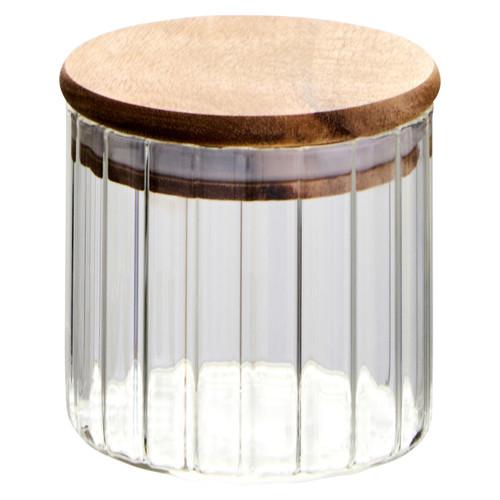
Freska Ribbed Round Glass Jar with Acacia Wood Lid 250ml
£19
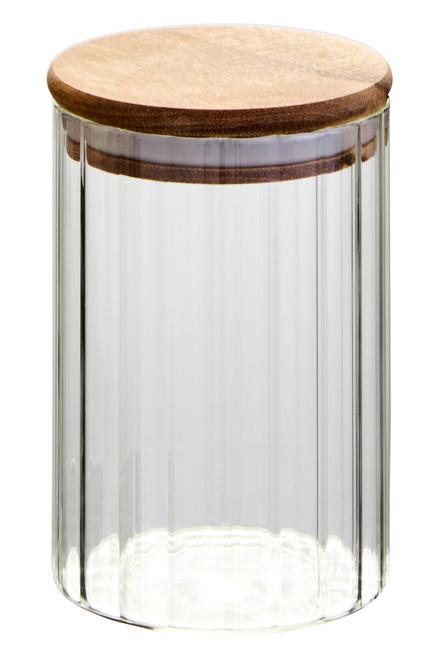
Freska Ribbed Round Glass Jar with Acacia Wood Lid 550ml
£19
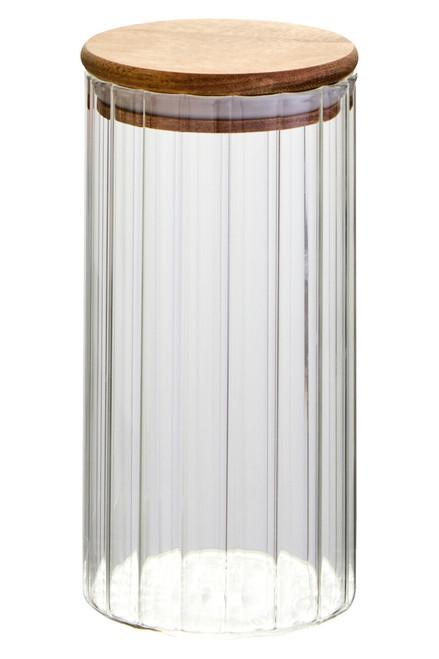
Freska Ribbed Round Glass Jar with Acacia Wood Lid 800ml
£19
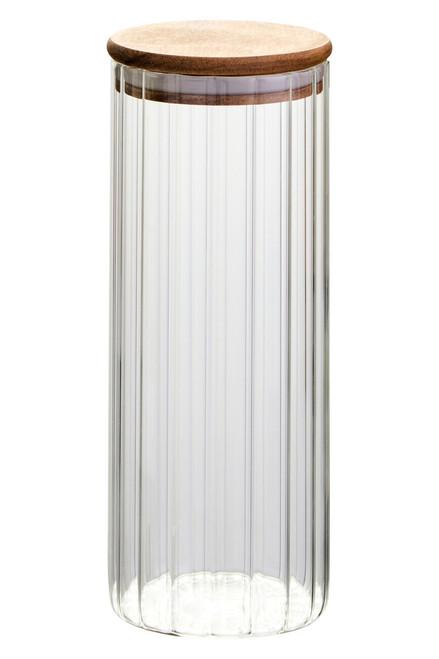
Freska Ribbed Round Glass Jar with Acacia Wood Lid 1100ml
£19
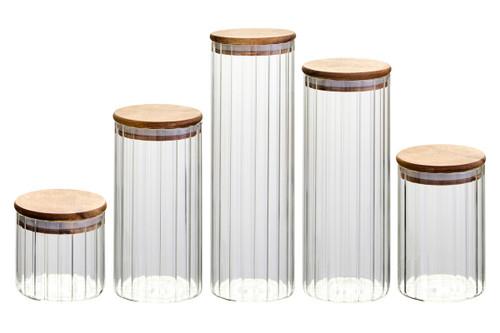
Freska Set of Five Ribbed Round Clear Glass Jars with Acacia Wood Lids
£34
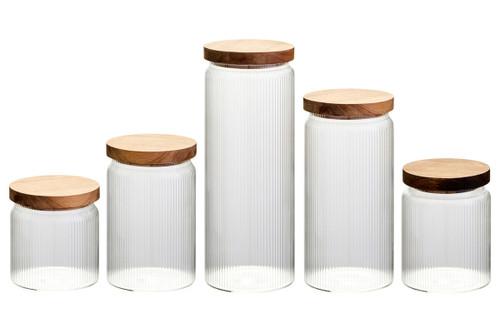
Freska Set of Five Ribbed Round Glass Jars with Acacia Wood Lids
£40